Escape Into Books
Your home for book news, reviews, and bookish fun. Follow along on Facebook.
Escape Into Books
Your home for book news, reviews, and bookish fun. Follow along on Facebook.


Explore the recommended reading order for the Dune series, starting with Frank Herbert's original works.
If you are looking for the best way to read the Dune books in order, the most rewarding path is also the simplest: start at the very beginning with Frank Herbert’s 1965 masterpiece and follow the original publication line. Frank Herbert wrote six core novels between 1965 and 1985, building a vast sci-fi sequence that remains the undisputed foundation of the entire literary saga.
While the broader expanded universe has since grown to span over 20 novels including prequels, spin-offs, and sequels, attempting to tackle everything in strict chronological order can quickly overwhelm a newcomer. I bounced off God Emperor of Dune twice before it clicked, but sticking strictly with the original sequence as published is still the richest way to experience Arrakis, its ecology, and its complex political intrigue.
This guide breaks down each of the six original Frank Herbert titles, outlining how the grand narrative evolves across the generations. We will also cover where readers most commonly decide to step off the desert sands, how the later continuation books written by Brian Herbert and Kevin J. Anderson fit into the wider picture, and how to navigate the full reading order without getting lost in the spice.
When approaching Arrakis for the first time, you are immediately confronted with a choice between two distinct paths: publication order and chronological order. Publication order begins with Frank Herbert’s masterwork, Dune, published in 1965, and follows his original release sequence straight through to 1985. This six-book run delivers the story in the exact order it was conceived, allowing you to watch the author’s ideas about power, ecology, and religion evolve across two decades of writing.
Chronological order takes a radically different approach by rearranging the entire franchise timeline. This method places the extensive library of expanded universe prequels, penned by Brian Herbert and Kevin J. Anderson from 1999 onwards, at the very front of your reading list. In a strict chronological run, you would encounter the Caladan trilogy, comprising The Duke of Caladan (2020), The Lady of Caladan (2021), and The Heir of Caladan (2022), long before you ever open the original 1965 novel.
I attempted a chronological re-read a few years ago, and it quickly confirmed my long-standing suspicion: starting with the prequels is a tactical error for new readers. Frank Herbert designed his universe to be discovered through a process of immersion and gradual revelation. He drops you into the deep end of imperial politics and Bene Gesserit schemes, trusting you to figure out the culture alongside Paul Atreides.
When you start with prequels, that mystery evaporates. Prequel novels inevitably spell out backstory that was meant to remain enigmatic or be revealed much later in the main sequence. Reading chronologically spoils major thematic reveals and flattens world-building that was specifically crafted to unfurl across the original six books. For the purest and most satisfying experience, stick to the order in which the universe was originally built.
| Book | Author | First published | Best for |
|---|---|---|---|
| Dune | Frank Herbert | 1965 | First-time readers and original sci-fi fans |
| Dune Messiah | Frank Herbert | 1969 | Readers wanting Paul’s complete arc |
| Children of Dune | Frank Herbert | 1976 | Fans of political intrigue and legacy |
| God Emperor of Dune | Frank Herbert | 1981 | Readers who enjoy deep philosophical sci-fi |
| Heretics of Dune | Frank Herbert | 1984 | Fans of expanded galactic lore |
| Chapterhouse: Dune | Frank Herbert | 1985 | Completing Frank Herbert’s original series |
First published 1965Length 605 pages
Borrow or find an edition on Open Library
First published in 1965, Dune is the landmark original novel by Frank Herbert that launched one of the most influential sagas in science fiction. It introduces readers to the harsh desert planet Arrakis, young nobleman Paul Atreides, and the spice melange, the priceless resource that drives galactic politics, interstellar travel, and religion. As the foundational entry in Herbert’s original six-book sequence, it sets the sprawling political and ecological stage upon which the entire universe rests.
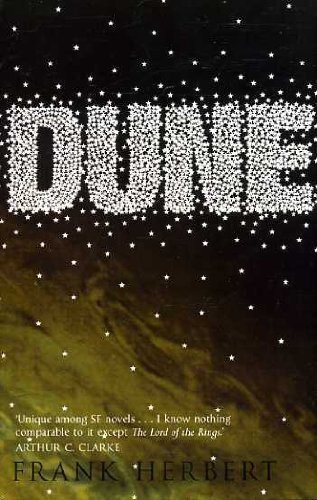
It remains an extraordinary piece of worldbuilding, dense with layered history, feudal house rivalries, and deeply considered desert mechanics. Herbert consciously eschewed traditional sci-fi tropes of bright metallic spaceships to focus on human evolution, political manoeuvring, and ecological fragility. I bounced off it twice before it clicked, but once you adjust to its deliberate pace, the atmosphere is unmatched. Not everyone loved it instantly, of course; J.R.R. Tolkien disliked Dune intensely in a private letter written shortly after its release. Yet for generations of readers, its rich tapestry of messianic prophecy and spice-driven conflict has proven irresistible.
Serving as the primary basis for major screen adaptations, Dune remains the essential starting point for first-time readers and long-time sci-fi fans alike. It works wonderfully as a self-contained narrative if you decide not to venture further into the desert, but it also plants every major thematic seed that germinates across Herbert’s later work. If you are looking to enter Arrakis for the first time, this is unconditionally the book to pick up first.
First published 1969Length 279 pages
Borrow or find an edition on Open Library
First published in 1969, Dune Messiah is the direct sequel to Dune and the logical next step for anyone following the original Frank Herbert sequence. Where the original novel built Paul Atreides into a charismatic, larger-than-life figure who brings a galactic empire to its knees, this second instalment deliberately dismantles that myth. It deconstructs the hero narrative established in the first novel, stripping away the romantic illusion of a clean victory to expose the terrifying consequences of charismatic leadership and messianic fervour.
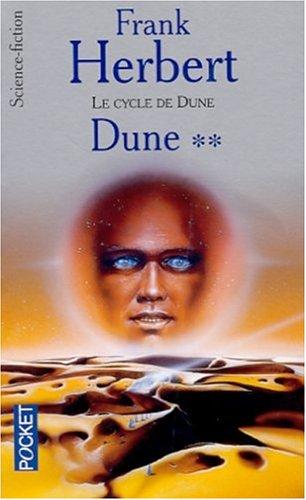
Clocking in as the shortest entry in Frank Herbert’s original six-book series, it offers a remarkably focused reading experience. While certain omnibus listings reference typical lengths around 920 pages for combined volumes, this individual book is far tighter and more compressed than the epic that preceded it. Instead of sweeping battles across open sands, the narrative moves indoors to the claustrophobic corridors of power on Arrakis. It trades grand military strategy for quiet palace intrigue, conspiracy, and political debate, making the universe feel intensely personal and quietly dangerous.
For readers wanting Paul’s complete arc, skipping this entry is simply not an option. If you stop at the end of the first novel, you miss the true climax of Paul’s personal story and the actual point Herbert was trying to make. I was initially thrown by its darker tone when I first turned the pages, but it quickly became clear that this book is what elevates the series from a classic adventure into something far more profound. It bridges the gap between the initial rebellion and the massive temporal leaps that follow, making it a critical read before moving deeper into the franchise.
First published 1976Length 504 pagesReaders 3.96/5 from 47 Open Library ratings
Borrow or find an edition on Open Library
First published in 1976, Children of Dune brings the initial Atreides family trilogy to a dramatic close. Running at about 504 pages, this third instalment shifts the focus from Paul onto his twin children, Leto II and Ghanima. Born with the full ancestral memory of their lineage and prescient abilities that threaten to consume them, the twins must navigate a treacherous political landscape while their aunt Alia rules as regent over an empire on the brink of religious frenzy.

This is the book I hand to readers who missed the heavy political scheming of the original novel after the more insular narrative of the second. It caters brilliantly to fans of political intrigue and legacy, digging deep into how the ecological transformation of Arrakis is altering the planet’s culture and economy. On Open Library, it holds a rating of 3.96 out of 5 from 47 ratings, reflecting how comfortably it picks up the sprawling scope of the original narrative.
It is an essential read for anyone following Frank Herbert’s universe. Beyond wrapping up the immediate conflict surrounding Paul’s bloodline, it sets the stage for the dramatic timeline leap in the next instalment, God Emperor of Dune, introducing the radical path Leto II must take to ensure humanity’s survival.
First published 1981Length 475 pagesReaders 3.95/5 from 75 Open Library ratings
Borrow or find an edition on Open Library
First published in 1981, God Emperor of Dune takes a staggering leap forward into the timeline, picking up the story thousands of years after the events of Children of Dune. The sweeping grand strategy and desert skirmishes of the early trilogy give way to a radically changed universe under the total rule of Leto II. Having transformed himself into a human-sandworm hybrid, Leto enforces a oppressive, multi-millennium peace across the cosmos to ensure his Golden Path, a brutal sacrifice designed to save humanity from ultimate extinction. It is a vast, daring concept that reframes the entire mythos of Arrakis.

Running to about 475 pages, this is the instalment where the series firmly pivots from action-driven space opera into long-form political and metaphysical debate. I bounced off it twice before it clicked, but once you accept that most of the novel consists of an ancient tyrant conversing with his guards, commanders, and a fresh clone of Duncan Idaho, its strange magic takes hold. It holds a reader rating of 3.95 out of 5 from 75 ratings on Open Library, which feels entirely accurate for a book that deliberately trade momentum for dense worldbuilding. It is tailor-made for readers who enjoy deep philosophical sci-fi, though it certainly explains why Tolkien disliked Dune intensely when looking at Herbert’s eccentric narrative directions.
Ultimately, this fourth novel serves as the ultimate litmus test for Frank Herbert’s universe. It is widely recognised as a major turning point in the series where casual readers decide whether to push forward or call it quits. If you love Leto’s tragic, terrifying grand vision, the final two original novels will be an absolute treat. If you find yourself longing for traditional heroics and straightforward plotlines, this is usually the natural stopping point.
First published 1984Length 512 pagesReaders 3.87/5 from 54 Open Library ratings
Borrow or find an edition on Open Library
First published in 1984, Heretics of Dune launches a completely new era for the series, jumping fifteen hundred years into the future following the death of the God Emperor. At roughly 512 pages, it represents a dramatic gear shift from the claustrophobic, philosophical monologue of the fourth book. The long shadow of Leto II still hangs over Arrakis, but the galaxy has fractured and changed beyond recognition. For readers who found the fourth novel a heavy read, this fifth instalment breathes fresh life into the franchise by completely refreshing the cast and faction dynamics long after the era of the tyrant. I remember being pleasantly surprised by how briskly the plot moves once the new players step onto the board.
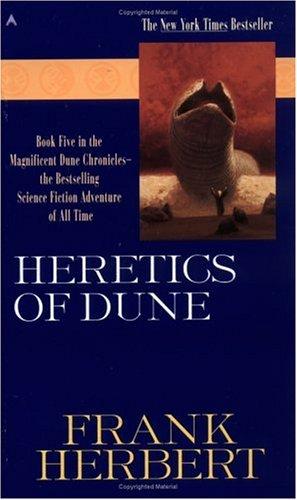
The central engine of the story is the chaotic return of forces from the Scattering, the massive outward migration of humanity that occurred after the fall of the God Emperor. Chief among these returning factions are the Honored Matres, a ruthless and violent matriarchal order that serves as a dark mirror to the Bene Gesserit. Their aggressive push back into the Old Empire threatens to burn down the established power structures of the Known Universe, forcing the Bene Gesserit, the Tleilaxu, and a fresh cycle of Ghola advisers into desperate, high-stakes games of survival.
This novel sits comfortably as a favourite for fans of expanded galactic lore who want to see how deep the worldbuilding can go. While it carries a rating of 3.87 out of 5 from 54 ratings on Open Library, it is easily one of the most inventive entries in Frank Herbert’s original sequence. It sets up the final movements of the classic series while proving that the universe had plenty of scope left to explore beyond the Atreides family line.
First published 1985Length 495 pages
Borrow or find an edition on Open Library
First published in 1985, Chapterhouse: Dune serves as Frank Herbert’s sixth and final novel in the series, completing his original core sequence. Clocking in at around 495 pages, it picks up the narrative directly following the dramatic events of the fifth book, shifting the focus away from the sands of Arrakis to the hidden citadel of the Sisterhood. Readers who have followed the saga this far will encounter a story that is tight, atmospheric, and deeply invested in the long-term mechanics of human survival.

The narrative focuses heavily on the Bene Gesserit’s struggle for survival on their secret world, known as Chapterhouse. Facing extinction from the ruthless Honored Matres who have swept in from the Scattering, the Sisterhood must make agonising strategic choices to preserve their order and their visions for humanity. Central to their plan is a desperate attempt to convert their lush, green sanctuary planet into a dry desert capable of supporting sandworms, thereby securing a private supply of the spice melange. It is a novel built on intense dialogue, ideological clashes, and tactical cunning rather than grand military combat. I found myself hooked by the quiet tension of these secret council rooms, where every decision carries the weight of millennia.
What every reader needs to know before finishing this final page is that the book ends on a major cliffhanger. Herbert was planning a seventh novel before his death, meaning the story arc he started in 1965 remains tantalisingly open at the close of this volume. That unresolved ending was later picked up by Brian Herbert and Kevin J. Anderson, who used Frank Herbert’s surviving working notes to continue the franchise with further sequels and prequels. Even with its abrupt final beats, this novel stands as an essential, fascinating piece of science fiction history that brings the creator’s direct contribution to a close.
When people search for Dune books in order, they are usually trying to figure out where the core story ends and where the extra homework begins. The original six novels published between 1965 and 1985 represent Frank Herbert’s complete original vision. Beginning with Dune (1965) and running through Dune Messiah (1969), Children of Dune (1976), God Emperor of Dune (1981), Heretics of Dune (1984), and ending with Chapterhouse: Dune (1985), this sequence remains the definitive backbone of the entire universe. Even contemporary authors had strong feelings about it back in the day; Tolkien disliked Dune intensely when he first read it, but for millions of readers, that original hexalogy is holy writ.
In practice, a massive portion of the fanbase never actually makes it through all six of Frank Herbert’s books. A great many readers choose to stop after the initial trilogy of Dune, Dune Messiah, and Children of Dune. That trio forms a self-contained, deeply satisfying narrative arc following Paul Atreides and his immediate heirs before the timeline leaps forward thousands of years into the wild, deeply philosophical terrain of God Emperor of Dune. Stopping at book three gives you a complete, brilliant story without forcing you to grapple with golden paths, bizarre alien transformations, or complex distant-future politics.
For those who do venture beyond the original canon, the expanded universe is a vast commitment. Frank Herbert died in 1986, leaving the story open after Chapterhouse: Dune. Thirteen years later, the franchise expanded significantly when Brian Herbert and Kevin J. Anderson stepped in, starting with House Atreides in 1999. They went on to write dozens of prequels, side stories, and direct continuations, including Hunters of Dune (2006) and Sandworms of Dune (2007), which were intended to wrap up the grand narrative arc left unfinished by Frank Herbert’s death. Whether you stick strictly to the original six or plunge into the expanded bibliography, knowing where that fundamental shift in authorship happens helps you decide exactly how far down the Arrakis rabbit hole you want to go.
The franchise expanded to 23 books because Frank Herbert’s son, Brian Herbert, alongside author Kevin J. Anderson, wrote numerous prequels and sequels after the original author passed away. Beginning with House Atreides in 1999, their additions include expansive prequel series such as the Caladan trilogy and direct sequels like Hunters of Dune (2006) and Sandworms of Dune (2007) to complete the overarching saga.
You should aim to read at least the first three novels, though finishing all six gives you Frank Herbert’s complete, unfiltered vision. I bounced off God Emperor of Dune on my first try before realising how brilliant its strange perspective actually is. While the later Herbert titles shift drastically in scope and tone, they remain essential reading for anyone who wants the author’s original narrative arc in full.
 Best Sci Fi Books: September 2026 and Where to Start

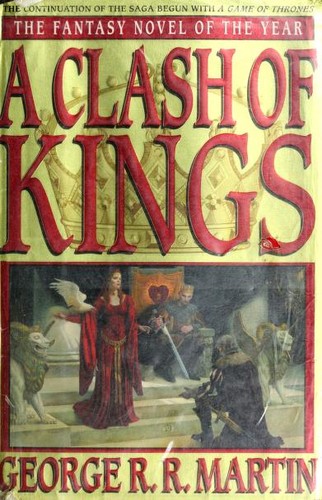
 Game of Thrones Books in Order, and Where Winds of Winter Stands

 Every Stephen King Book in Chronological Order
This page is maintained by Theo Marsh, who covers the big fantasy and science-fiction franchises for Escape Into Books.
Covers, author credits and reader ratings come from Open Library, which is free and openly licensed. A rating is only shown once enough people have left one.
Nothing here is generated from a book we could not verify. Where a title could not be confidently matched, we leave the space empty rather than guess.
We re-check this page every 90 days. The review date moves only when the content actually changes, because a fresh date on unchanged text helps nobody.
Last reviewed


